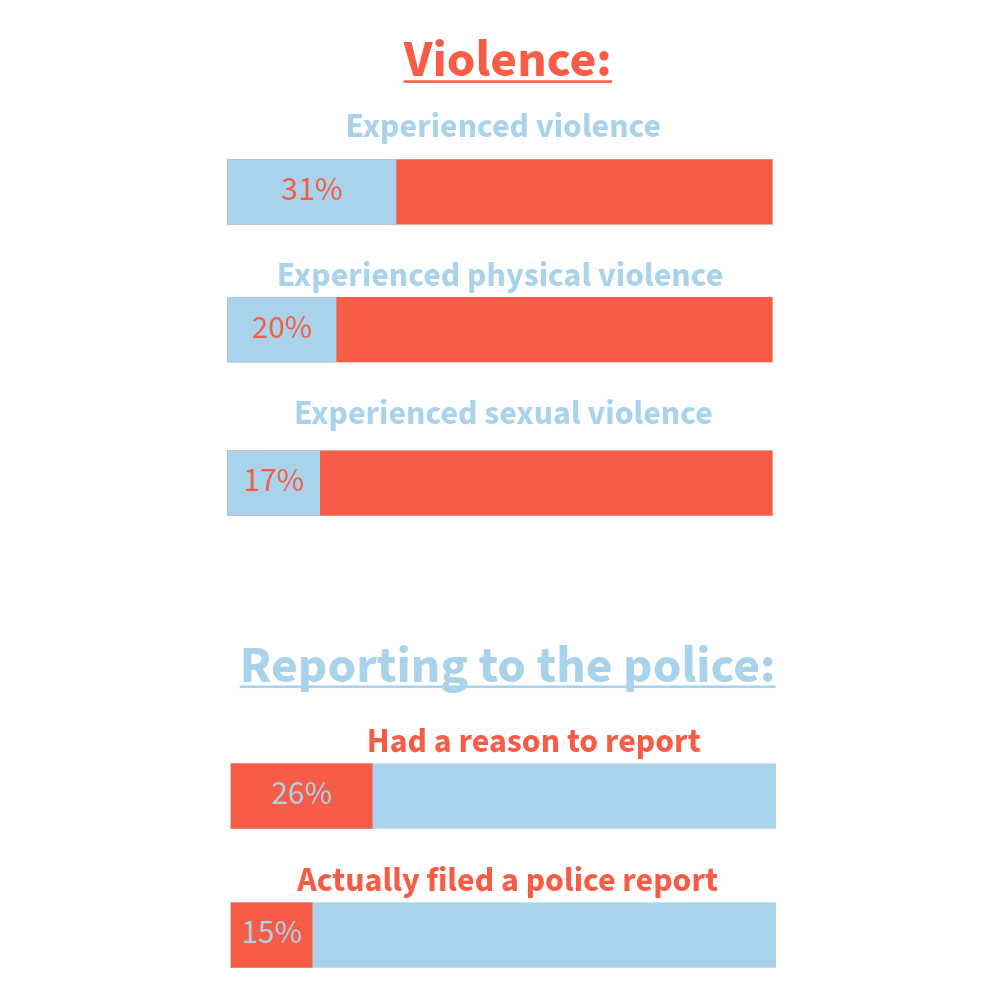
Sex workers face a real and ongoing risk of violence. In the past six months, 31% of sex workers experienced physical and/or sexual violence. This risk is the same for everyone: it does not depend on gender, age, residence status, income, or the number of clients. Research shows that violence is the only issue for which no clear determining factors were found. In other words: violence is not caused by who someone is, but by the situation they work in.
Looking more closely, 20% experienced physical violence and 17% experienced sexual violence. These numbers are lower than during the COVID-19 pandemic, when 41% reported violence, but they are still very high. The pandemic showed how quickly safety can disappear when support systems fall away. This means that in future crises, sex workers will again face a higher risk of danger.
There has been some improvement in reporting violence. Of the 26% of sex workers who had reason to report an incident, 15% actually filed a police report. This is better than during COVID-19, when only 5% did so, but still lower than the 20% reported in 2018. Many sex workers still hesitate to contact the police. 70% did not go to the police at all, and 18% say they experience the police as making their situation more dangerous, rather than safer.
These figures show an important reality: formal institutions alone cannot guarantee safety. Laws and police matter, but they do not cover everything. Safety is also shaped by what happens in everyday life, in streets, apartment buildings, and neighbourhoods.
This is where neighbours play a crucial role.
Neighbours are often the people who are closest by. They may hear noises, notice unusual situations, or see when something does not feel right.
A neighbour who stays alert, without judging or spreading gossip, can make a real difference. Sometimes this means checking in. Sometimes it means calling for help. Sometimes it simply means being present and paying attention.
For sex workers, supportive neighbours reduce isolation. They increase the chance that violence is noticed early and that help arrives in time. When neighbours choose awareness over indifference, they help create a safer environment for everyone.